
Hangul Builder: Learn Korean by AISolve

Hangul Builder — learn the Korean alphabet by building syllables

Keep learning, even when you start to forget.

Hangul is made of parts: consonants and vowels that fit together into blocks. Hangul Builder lets you learn to read and write it the same way — by building each syllable from its parts.

For iPhone and Android · Free to start

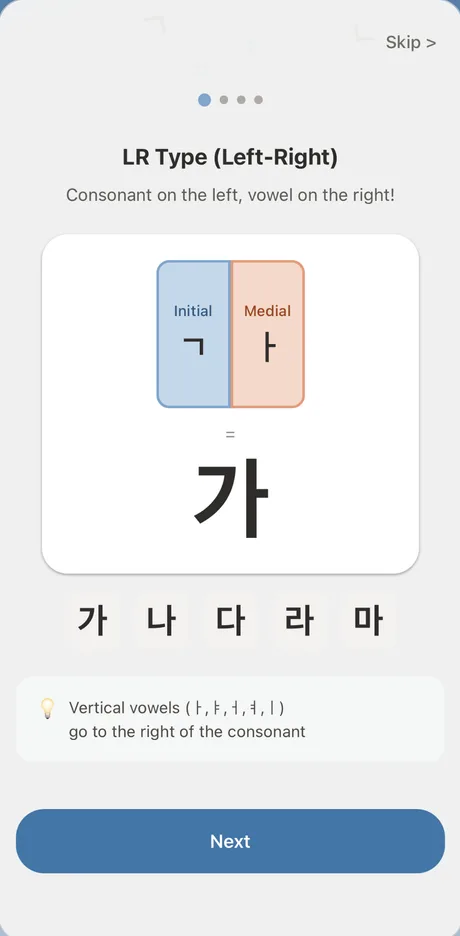
Screen explaining how a consonant and a vowel combine side by side to make 가
Why we built it

It started with building, not memorizing

It began when the developer taught Hangul to his son. Instead of memorizing each letter, he showed him how consonants and vowels fit together — and his son learned to read quickly. But apps that teach Hangul this way were hard to find. So he built one.

The app was first made for Japanese speakers. The English edition was written for English speakers, and explains pronunciation by comparing Korean sounds with English ones.

Jinchul Oh, CEO, AISolve, Inc. (born in Korea, living in Japan for about 20 years)

How Hangul works

An alphabet you build

Take 가 (ga): it is the consonant ㄱ plus the vowel ㅏ. Hangul has 14 basic consonants and 10 basic vowels, and together they make 140 combinations. Once you know how the parts fit, you can start sounding out letters you've never seen before.

See the Hangul chart and how to read it → How to learn Hangul →

Chapter 1 · The Basics Forest — 140 basic syllables, Day 1–7

Over seven lessons (Day 1–7), you learn the 140 syllables made from the 14 basic consonants and 10 basic vowels.

  • Build syllables by dragging consonants and vowels into place, like a puzzle
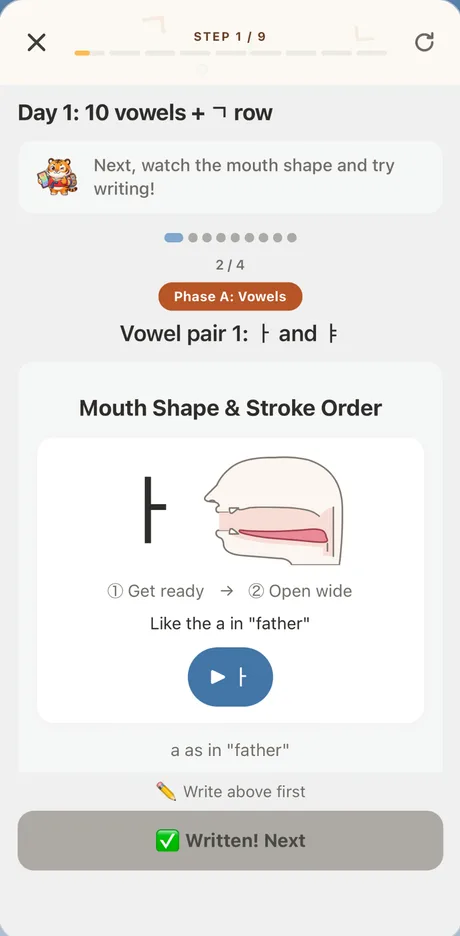
  • Watch the stroke order, then trace each letter with your finger (stroke order and balance are checked automatically)
  • Vowels explained through the "heaven, earth, person" idea behind their shapes
  • Pronunciation tips that compare Korean sounds with English ones
See the Hangul chart and how to read it →
Screen showing the mouth shape and stroke order for the vowel ㅏ

Then six more chapters, and typing

Clear Chapter 1, and the next chapters open one by one. Chapter 7 opens when you pass the last Typing Studio stage (S4).

Chapter 2

Batchim Village

The 7 batchim sounds — the consonant at the bottom of a syllable

간 ㄴ at the bottom

Chapter 3

Double Consonant Valley

5 double consonants, learned in pairs with their plain counterparts

까 ㄱ → ㄲ

Chapter 4

Compound Vowel Island

11 compound vowels like ㅘ and ㅙ

와 ㅗ + ㅏ

Chapter 5

Travel Hangul Harbor

Read the signs and menus you'll see on a trip

메뉴 menu

Chapter 6

Kumitate Words Street

Build 140 words from the letters you've learned (kumitate means "build" in Japanese)

김치 kimchi

Chapter 7

Connect Square

Use the Hangul you can type to search, chat, introduce yourself and place an order

검색 search

Typing Studio

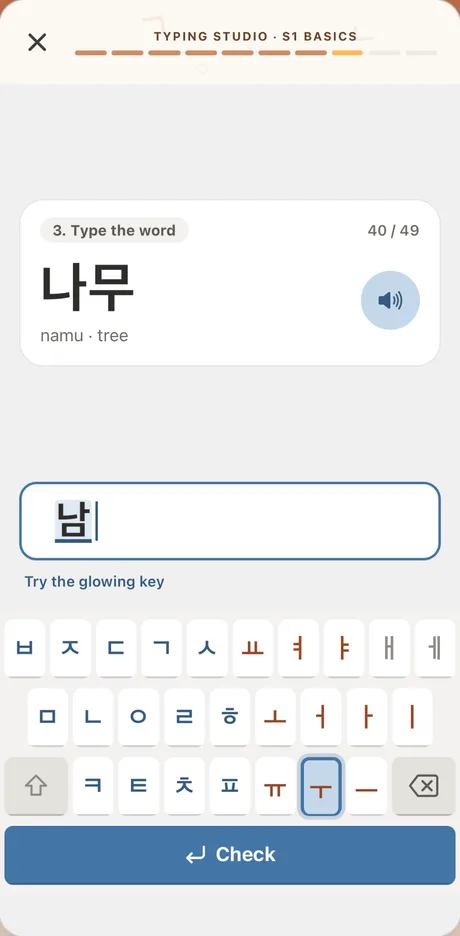
Practice typing the letters you've learned. New stages open as you clear chapters, leading to Chapter 7.

See the Korean keyboard layout and how to type →
Typing Studio screen, partway through typing the word 나무 on an on-screen Hangul keyboard

Keep learning, even when you start to forget

Almost no one remembers everything after learning it once. Hangul Builder isn't meant to be finished after Chapter 1 and put away — it's built for coming back whenever things start to slip.

  • Go back into any chapter you've cleared and review it
  • Replay any Typing Studio stage you've cleared
  • Spaced-repetition (SRS) reviews help bring back letters you're starting to forget
  • Day lessons and the Typing Studio pick up where you left off
  • Go at your own pace

Free to start

Get started with Hangul Builder

Free to start. To keep learning, get Premium (monthly subscription or one-time purchase).

Prices and terms shown on the in-app purchase screen are the most up to date.

iPhone
Android
  • Learning results vary from person to person and are not guaranteed.
  • Audio playback requires Korean voice data on your device. Depending on your device and settings, audio may not play.
  • Apple and the Apple logo are trademarks of Apple Inc., registered in the U.S. and other countries. App Store is a service mark of Apple Inc.
  • Google Play and the Google Play logo are trademarks of Google LLC.